
Copy Trading VS Options Trading VS CFD and Crypto: Which Strategy Fits Your Goals?

TradingCup
APR 08 2025
Last Updated: April 04, 2025
This article is reviewed annually to reflect the latest market regulations and trends.
TL;DR:
- Copy Trading is best for beginners and passive income seekers. You follow top traders (like past TradingCup champions) and mirror their trades.
- Options Trading allows for strategic, high-risk bets on market direction, great for advanced traders, but complex and time-consuming.
- CFD Trading gives access to leverage and multiple markets, but it’s riskier due to potential large losses.
- Crypto Trading is highly volatile and prone to scams; not ideal unless you understand blockchain markets deeply.
Pro Tip: Copy trading on platforms like TradingCup offers transparency (leaderboards, signal filters) and a safer entry point, especially in Forex, compared to DIY crypto or leveraged instruments. Choose based on your experience, risk tolerance, and time.
🔗 Related Reads:
Disclaimer: The information in this article is for educational purposes only and does not constitute financial, investment, or trading advice. Copy trading carries substantial risks, including the potential loss of your entire invested capital. Past performance of copied traders or strategies is not a reliable indicator of future results. You may be replicating high-risk trades, overleveraged positions, or strategies incompatible with your financial goals. Always conduct independent research into a trader’s historical performance, risk metrics, and strategy before copying them. Never invest funds you cannot afford to lose. Consult a licensed financial advisor to ensure copy trading aligns with your risk tolerance, financial objectives, and regulatory requirements in your jurisdiction. This article does not endorse specific traders, platforms, or strategies, and all trading decisions remain your sole responsibility.
Comparative Analysis
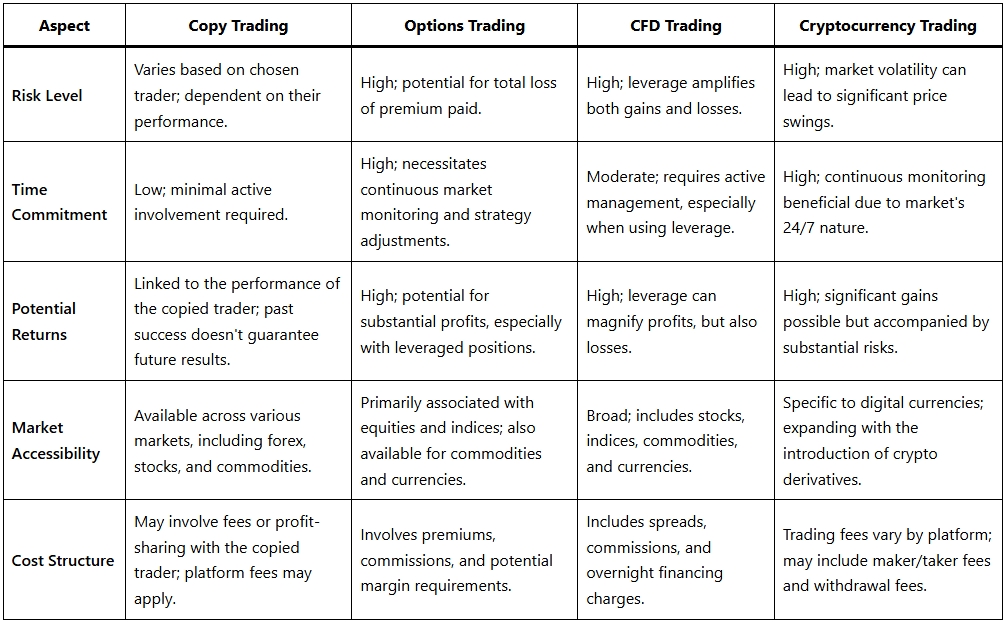
Understanding the Trading Instruments
1. Copy Trading:
- Mechanism: Automatically replicates the trades of experienced investors. By selecting a trader to follow, your account mirrors their trading activities in real-time.
- Accessibility: Ideal for beginners or those lacking time for market analysis.
- Control: Limited, as trades are executed based on the chosen trader’s decisions.
2. Options Trading:
- Mechanism: Involves contracts granting the right, but not the obligation, to buy (call) or sell (put) an underlying asset at a predetermined price before a specific date.
- Flexibility: Offers strategies for various market conditions, including bullish, bearish, and neutral outlooks.
- Complexity: Requires understanding of market dynamics and option strategies.
3. Contracts for Difference (CFDs):
- Mechanism: Allows speculation on the price movement of assets without owning them. Profits or losses are determined by the difference between the opening and closing prices of the contract.
- Leverage: Typically offers higher leverage, amplifying both potential gains and losses.
- Ownership: No ownership of the underlying asset.
4. Cryptocurrency Trading:
- Mechanism: Involves buying and selling digital currencies like Bitcoin and Ethereum. Can be conducted through spot markets or via derivatives like futures and options.
- Volatility: Known for significant price fluctuations, presenting both opportunities and risks.
- Market Hours: Operates 24/7, unlike traditional financial markets.
Why New Traders Struggle: Common Hurdles
Before diving into strategies, let’s address why many newcomers fail:
- No time to learn: Mastering technical analysis, chart patterns, and market jargon requires hours most don’t have.
- Fear of losing capital: Trial-and-error trading risks significant losses, especially with leveraged products like CFDs.
- Analysis paralysis: Conflicting advice from forums, influencers, and “gurus” creates confusion.
- Budget constraints: High initial investments exclude many from traditional markets.
- Emotional trading: Fear and greed often override logic, leading to impulsive decisions.
The solution? Strategies that minimize learning curves, automate decisions, and cap risks. Let’s explore your options.

Cost Analysis: Equations for Low-Risk Scenarios
1. Copy Trading
- Costs: Performance fee (% of profits) + subscription fee, both or either.
Example: A 10% gain on a $1,000 trade with a 20% performance fee yields $98 net profit.
2. Options Trading
- Costs: Premium paid + brokerage fees.
- Equation: Breakeven Price=Strike Price + Premium (Call)
Example: Buying a $50 call for a $2 premium requires the underlying asset to hit $52 to profit.
3. CFD Trading
- Costs: Spread + overnight financing.
- Equation: Daily Cost = Position Size × Overnight Rate × Days 365
Example: Holding a $10,000 position at a 5% annual rate costs $1.37 daily.
4. Crypto Trading
- Costs: Exchange fees (0.1–0.5%) + network/gas fees.
- Equation: Break-Even=Purchase Price × (1+Fee Rate)
Example: Buying Bitcoin at $30,000 with a 0.2% fee requires selling above $30,060.
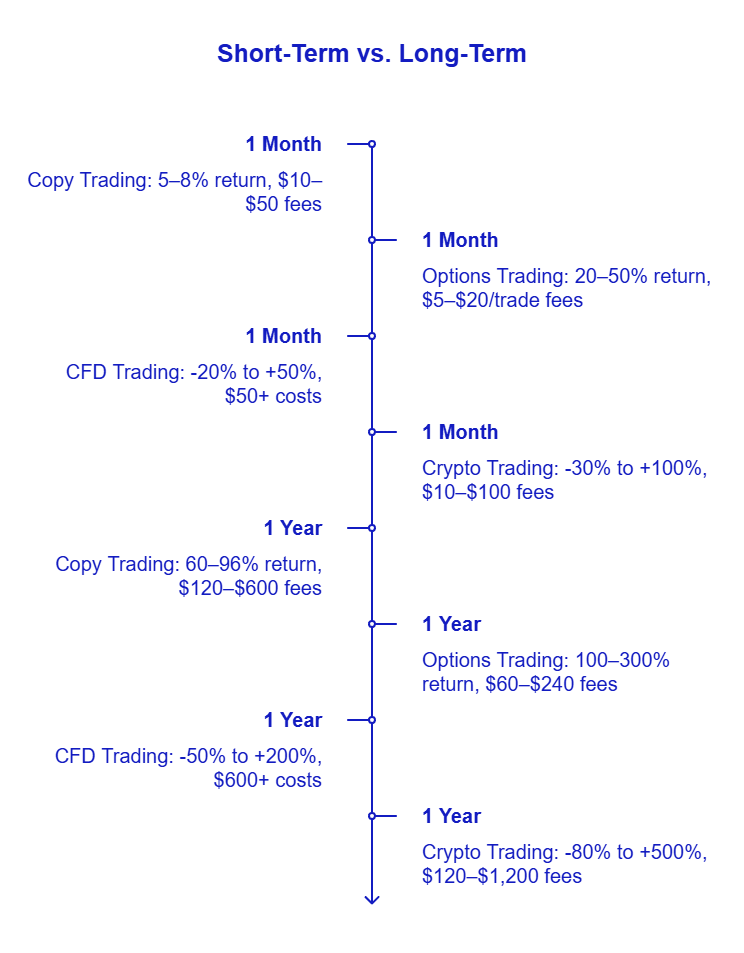
Short-Term vs. Long-Term Scenarios
Copy Trading
- 1 Month: 5–8% return, $10–$50 fees.
- 1 Year: 60–96% return (compounded), $120–$600 fees.
Options Trading
- 1 Month: 20–50% return (if in-the-money), $5–$20/trade fees.
- 1 Year: 100–300% return (consistent ITM trades), $60–$240 fees.
CFD Trading
- 1 Month: -20% to +50% (leveraged swings), $50+ spread/funding costs.
- 1 Year: -50% to +200%, $600+ cumulative costs.
Crypto Trading
- 1 Month: -30% to +100%, $10–$100 fees.
- 1 Year: -80% to +500%, $120–$1,200 fees.
Which Strategy Fits Your Goals?
1. Copy Trading: The Hands-Off Approach
- Best for: Beginners, busy professionals, risk-averse investors.
- Budget: Start with $100–$500.
- Platforms: TradingCup, Pepperstone, eToro.
- Low-Risk Tip: Diversify across 3–5 traders to mitigate single-strategy failures.
2. Options Trading: Hedging and Income
- Best for: Intermediate traders, income seekers.
- Budget: $200+ per trade.
- Low-Risk Play: Sell covered calls on existing stock holdings to generate premium income.
3. CFD Trading: Leveraged Speculation
- Best for: Experienced traders, short-term speculators.
- Budget: $500+ (use 1:5 leverage max).
- Low-Risk Tip: Set stop-losses at 2% of account balance per trade.
4. Crypto Trading: High-Risk, High-Reward
- Best for: Tech-savvy investors, long-term holders.
- Budget: Allocate ≤5% of portfolio.
- Low-Risk Play: Dollar-cost average into Bitcoin/ETH during dips.
Key Considerations
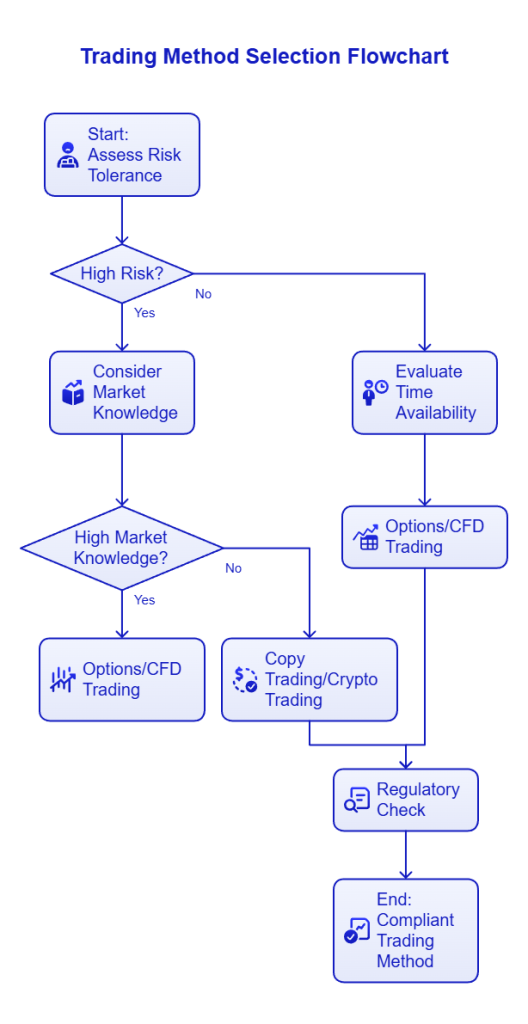
- Risk Tolerance: Assess your ability to withstand potential losses. High-leverage instruments like CFDs and options can result in losses exceeding initial investments.
- Market Knowledge: Options and CFD trading require a solid understanding of market mechanics and strategies. Copy trading and spot cryptocurrency trading may be more suitable for those with limited experience.
- Time Availability: Consider the time you can dedicate to trading. Copy trading offers a more hands-off approach, while options and crypto trading demand active involvement.
- Regulatory Environment: Ensure the chosen trading method complies with regulations in your jurisdiction. Some instruments may be restricted or subject to specific legal considerations.
— Warren Buffett
“Risk comes from not knowing what you’re doing.”
Final Thoughts: Protecting Your Capital
The lowest-risk strategy? Copy trading with diversification. By spreading funds across vetted traders and using platforms with transparent fee structures, you minimize single-point failures while leveraging others’ expertise. For DIY traders, selling covered calls or using CFD stop-losses offers controlled risk.
Future winners: Copy trading and AI-driven strategies will dominate as automation reduces emotional errors. Crypto’s role depends on regulatory clarity, but blue-chip tokens like BTC/ETH remain long-term holds.
Action Steps:
- Start with a demo account to test strategies risk-free.
- Allocate ≤10% of capital to high-risk trades (CFDs/crypto).
- Use AI tools to monitor sentiment and automate decisions.
By prioritizing education and risk management, even novice traders can navigate today’s complex markets confidently.

🔍 Answering Your Top Trading Questions:
1. Is Copy Trading Better Than Trading?
Answer:
Copy trading is ideal for beginners or those lacking time to master forex strategies or day trading. Unlike active trading (e.g., CFD trading or options trading), it automates decisions by mirroring experts. For passive income or a side hustle, copy trading reduces risks and learning curves.
2. What Are the 4 Types of Trading?
Answer:
The four primary strategies are:
- Copy Trading: Mirror experts passively (e.g., copy trading for beginners).
- Options Trading: Trade contracts (calls/puts) for hedging or speculation.
- CFD Trading: Speculate on leveraged price movements.
- Crypto Trading: Buy/sell cryptocurrency like Bitcoin or Ethereum.
3. What Is Better Than Option Trading?
Answer:
For low-risk extra income, copy trading outperforms options due to automation and lower capital requirements. However, options excel in hedging portfolios. Compare strategies like CFD trading or crypto trading based on your risk appetite.
4. Is Copy Trading Profitable?
Answer:
Yes, with proper strategy. Diversify across signal providers for free or low-cost platforms like TradingCup.
5. Which Type of Trading Is Best?
Answer:
- Beginners: Copy trading for beginners (low effort, $100+ start).
- Active Traders: Day trading forex or CFDs (higher risk/reward).
- Tech Enthusiasts: Cryptocurrency trading (volatile but high-growth).
6. Copy Trading vs Options Trading
Answer:
- Copy Trading: Passive, low learning curve, ideal for extra income.
- Options Trading: Requires understanding premiums/assignment, better for hedging.
👉 Learn more: Copy Trading Fees Guide
7. What Trading Is Most Profitable?
Answer:
- Short-Term: CFD trading (leveraged gains) or crypto trading (speculative pumps).
- Long-Term: Copy trading (compounded returns) or forex trading (stable pairs like EUR/USD).
8. What Are Option Trades?
Answer:
Options are contracts letting you buy/sell assets at set prices. Types:
- Calls: Bet on price rises.
- Puts: Bet on drops.
Use for income (covered calls) or hedging.
9. How to Trade for Beginners?
Answer:
- Start with copy trading for free on demo accounts.
- Learn forex strategies (e.g., support/resistance).
- Allocate ≤10% to high-risk trades (CFDs, crypto).
👉 Beginner-friendly platform: TradingCup Sign-Up Guide
10. Which Option Is Most Profitable?
Answer:
In-the-money (ITM) calls/puts during volatility (earnings reports, Fed meetings). Example: A 50-call hitting 60 yields 100%+ returns.
11. Should I Avoid Option Trading?
Answer:
Not if you:
- Understand Greeks (delta, theta).
- Use covered calls for extra income.
Avoid naked options without experience.
12. Is Forex or Options Easier?
Answer:
Forex trading is simpler for beginners (fewer variables than options). Pair copy trading with forex strategies for hands-off gains.
13. Is Copy Trading Good for Beginners?
Answer:
Yes! It’s the best trade for beginners, requiring minimal capital ($250+) and zero expertise. Platforms like TradingCup vet top traders automatically.
14. What Is the Best Copy Trade Strategy?
Answer:
- Diversify across 3–5 signal providers.
- Prioritize traders with low drawdowns (<10%).
- Use platforms with copy trading for free trials.
15. What Is the 90% Rule in Trading?
Answer:
“90% of traders lose 90% of their capital in 90 days” due to poor risk management. Avoid this by:
- Using stop-losses.
- Limiting leverage (e.g., 1:5 for CFD trading).
16. Which Trade Is Best for Beginners?
Answer:
Copy trading or forex trading with stable pairs (EUR/USD). Start with a $1000 budget and scale using TradingCup’s Trending Strategies.
17. Which Trading Is Best to Earn Money?
Answer:
For consistency: copy trading (5–15% monthly). For high-risk gains: crypto trading or CFDs. Always prioritize risk management!
For more detailed insights on developing daily trading routines, risk management, and effective position sizing strategies, explore additional articles on Trading Cup. Our trading experts at ACY and FinLogix are also great resources to guide your journey towards trading excellence.

Discover Our Best Trading Signals
At Tradingcup, you can browse through a selection of signals and review past performance before you decide to copy.
Become A Signal Provider
Share your expertise and become a signal provider so other traders can copy your trades.
Stay tuned to our blog for more trader spotlights and leaderboard updates.
Trading involves risks.
Visit the Tradingcup blog through the link below for more updates: https://www.tradingcup.com/learn
For further reading, visit acy.com