
Is M MATH the Best Non-Martingale Strategy for Gold Copy Trading Signals?

Peter Pan
MAR 12 2026
Last Updated: March 03, 2026
This article is reviewed annually to reflect the latest market regulations and trends
Discover why a 55% win rate on Gold and a non-Martingale strategy are the keys to long-term survival.

TL;DR: How to Identify Professional Gold Trading Signals in a Crowded Market?
- Prioritize Risk Management: The real factor separating professional investors from the rest is the ability to distinguish a mathematical edge from a high-risk trap. To protect your capital, you must look beyond surface-level returns and understand how to trade XAUUSD by identifying traders who prioritize survival.
- Avoid Account-Blowing Traps: While many leaderboard signals rely on dangerous forex martingale strategies that eventually blow up accounts, M MATH utilizes a rare, disciplined non-martingale approach.
- Analyze Directional Accuracy: By applying a gold copy trading analysis to the current market, it is clear that MATH’s 55% win rate on gold is a masterclass in statistical directional accuracy rather than luck.
- Focus on Logic: Historical data proves that putting systematic risk management first is the only way to make long-term returns a natural outcome.
Disclaimer: The information in this article is for educational purposes only and does not constitute financial, investment, or trading advice. Copy trading carries substantial risks, including the potential loss of your entire invested capital. Past performance of copied traders or strategies is not a reliable indicator of future results. You may be replicating high-risk trades, overleveraged positions, or strategies incompatible with your financial goals. Always conduct independent research into a trader’s historical performance, risk metrics, and strategy before copying them. Never invest funds you cannot afford to lose. Consult a licensed financial advisor to ensure copy trading aligns with your risk tolerance, financial objectives, and regulatory requirements in your jurisdiction. This article does not endorse specific traders, platforms, or strategies, and all trading decisions remain your sole responsibility.

MATH Signal Review: Is This Non-Martingale Strategy the Smartest Way to Trade Gold?
In the world of trading, most people are drawn to big, flashy numbers.
Returns exceeding 100%, win rates above 80%; they sound compelling, but they’re often traps.
High returns come with devastating drawdowns. High win rates are built on razor-thin risk-reward ratios and sometimes carry an even greater risk of blowing up an account.
So, if we look beyond the surface-level glamour, what does a truly excellent strategy actually look like?
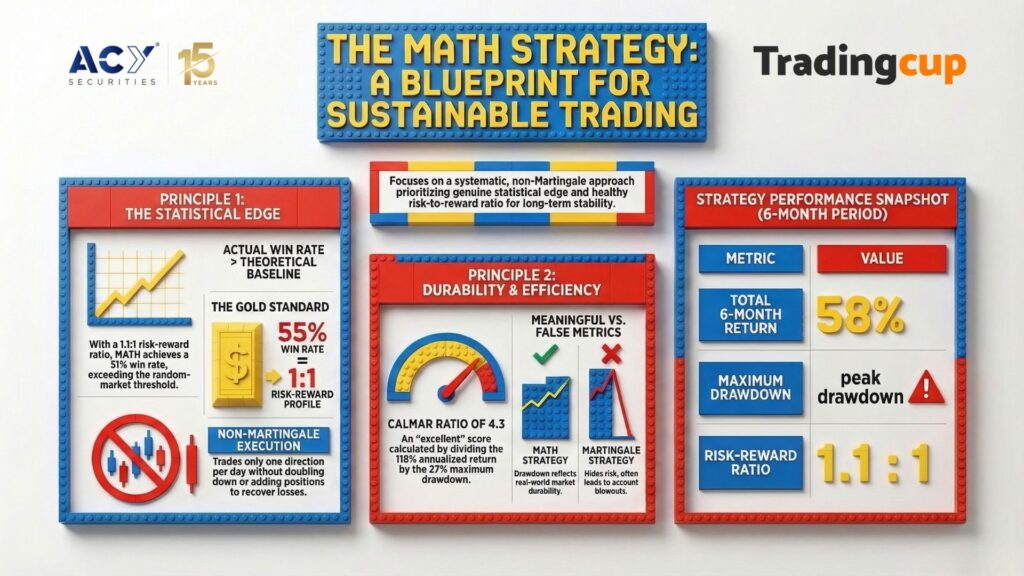
A trader on the Tradingcup leaderboard, M MATH, offers an answer worth studying. The MATH signal achieved a 58% return over six months, placing it in the top five. The numbers aren’t eye-popping; but on a leaderboard full of aggressive strategies, this one stands out for a different reason: it’s a rare non-Martingale strategy. It’s precisely this seemingly “ordinary” performance that makes it worth breaking down.

How Does Quantitative and Statistical Analysis Create a Measurable Trading Edge?
The MATH signal comes with a detailed strategy description, stating that its trading decisions rely on quantitative and statistical analysis — every trade is data-driven, with the goal of maximizing profit while keeping risk under control.
Trading Performance
Key Performance Metrics of the MATH Signal
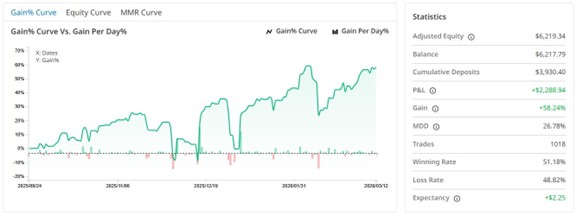
Based on trading records up to March 12, 2026, MATH’s key metrics are as follows:
- Initial Capital: ~$4,000
- Strategy Duration: 6 months
- Total Return: 58%
- Maximum Drawdown: 27%
- Win Rate (per trade): 51%
- Average Lot Size: ~0.03, stable, with no proportional reverse-compounding tendency
- Risk-Reward Ratio: ~1.1:1
- Long/Short Ratio: Close to 1:1, no directional bias
- Instruments Traded: Primarily gold; other instruments traded in smaller, diversified positions
- Trading Style: Highly systematic — trades only one direction per instrument per day, and never extends holding periods or adds opposing positions to recover losses
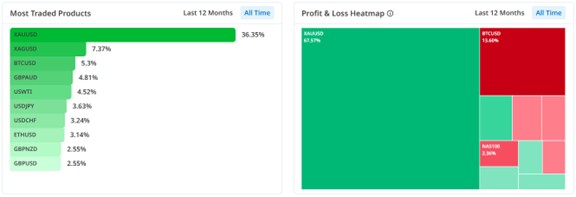
At first glance, it looks unremarkable: a mediocre win rate, a meaningful drawdown, and returns that won’t make headlines. Yet this strategy has delivered consistent, positive returns. The reason comes down to two things it gets right:
Why is an Actual Win Rate Above the “Random Walk” Baseline Essential?
In previous signal analyses, we’ve frequently referenced a key concept; the random walk win rate, also known as the theoretical win rate. This metric measures whether a strategy’s actual win rate holds a genuine statistical edge over what would be expected under random price movement.

Since financial market prices largely exhibit near-random behavior, the stop-loss and take-profit levels a strategy uses directly determine its theoretical win rate under random conditions. For example: if a short-term strategy sets a risk-reward ratio of 1:4 (small take-profit, large stop-loss), the theoretical win rate is approximately 80% (4 ÷ (1+4) ≈ 80%). Many Martingale-style strategies achieve seemingly high win rates for exactly this reason; price is more likely to reach a nearby take-profit than a distant stop-loss.
Conversely, when the take-profit and stop-loss are roughly equal (1:1), a strategy only needs a win rate consistently above 50% to be profitable; ignoring transaction costs. Factoring in costs, the threshold rises to around 52%.
For MATH, the risk-reward ratio of approximately 1.1:1 implies a theoretical win rate slightly below 50%. Yet MATH’s actual win rate is 51.18%. That gap may look small, but it is the foundation of long-term profitability.
This edge is even more pronounced in MATH’s gold trades. Across 370 gold orders, the point-based risk-reward ratio is close to 1:1; yet the win rate on gold reaches 55%. It’s this above-theoretical edge that makes gold the primary driver of overall returns.
Of course, improving a win rate is never easy. Even a 1% gain in win rate requires extensive practice, testing, and iteration. There are no free lunches in the market. That MATH achieves a 55%-win rate on gold suggests its mathematical model genuinely improves directional accuracy; without relying on high-risk Martingale techniques to get there.
How Does a Calmar Ratio of 4.3 Prove the Durability of the MATH Signal?
The Calmar Ratio is a core metric for evaluating the risk-reward structure of a strategy. It is calculated as: Annualized Return ÷ Maximum Drawdown. In simple terms, it tells you how much annual return a strategy generates for every unit of maximum drawdown risk taken.

As a general benchmark: a Calmar Ratio below 1 means the risk outweighs the reward; above 1 is a passing grade; only at 2 or above does a strategy demonstrate a genuinely favorable long-term risk-reward profile.
MATH scores impressively here. A 58% return over six months annualizes to approximately 116%. Divided by the current maximum drawdown of 27%, the Calmar Ratio comes to around 4.3; an excellent result.
It’s worth noting that MATH’s Calmar Ratio doesn’t reach the extreme highs seen in some Martingale strategies; but that’s precisely the point. Because the risk-reward ratio is close to 1:1, the recorded maximum drawdown is a reliable, meaningful figure. It genuinely reflects the risk the strategy faces under normal market conditions. Martingale strategies, by contrast, often show spectacular Calmar Ratios during calm periods; only to see drawdowns explode in a matter of days when losses compound, rendering all previous metrics meaningless.
MATH’s high Calmar Ratio therefore signals not just strong returns, but real durability; a strategy capable of sustaining performance over time, with risk and reward kept in genuine balance.
Who Should Consider Following the MATH Signal?
- Investors who prioritize quantitative logic over emotional trading.
- Traders looking for a non-Martingale alternative to high-volatility leaderboard signals.
- Experienced investors who understand that long-term compounding is better than chasing short-term “miracles”.
Conclusion: Is Mathematical Discipline the Key to Survival?
The market never runs short of “short-term miracles” that burn out in weeks. What is rare are strategies like MATH that can survive across cycles by relying on a win rate that exceeds the random baseline.
If your goal is to build a resilient portfolio based on factual numbers and disciplined execution, MATH offers an answer that is simple but rare: a strategy where the risk and reward are finally in balance.
Looking for the Best Copy Trading Strategy?
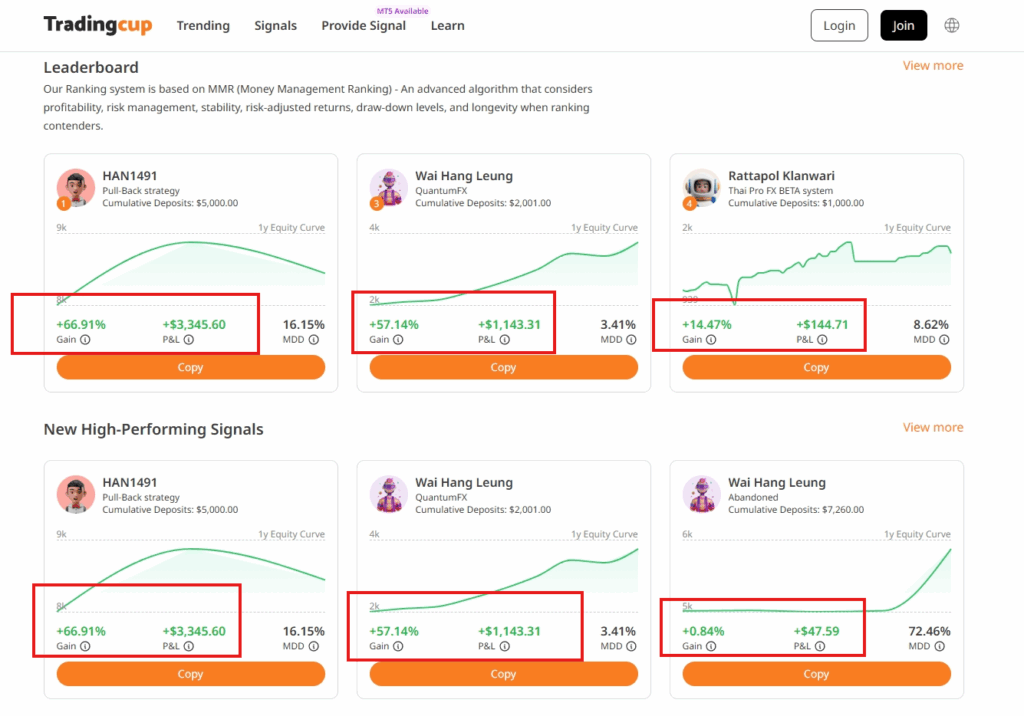
We’ve compiled a leaderboard of the most outstanding traders with excellent drawdown control and clear trading styles. This way, you’ll never feel lost when choosing who to follow and won’t blindly chase trends. Click to view the latest trader rankings and find out who is truly worth copying! Choose the right person, copy the right strategy, and from today, let copy trading truly create value for you.
Bonus Guide
What Makes an Effective Trading Portfolio?
- Diversification: Spread funds across various asset types (e.g., stocks, bonds, real estate, cash, precious metals) and industries/regions to reduce exposure to single-market volatility.
- Asset Allocation: Tailor allocations based on your risk tolerance, goals, and time horizon. Conservative portfolios emphasize fixed income, while aggressive ones lean into equities.
- Risk-Reward Balance: Each asset has different risk/return profiles. Ensure your portfolio avoids excessive exposure to high-risk or low-return assets.
- Low Correlation: Combine assets with correlations below 0.3 to enhance stability and provide a cushioning effect during market swings.
- Dynamic Rebalancing: Review and adjust your portfolio regularly as markets or personal goals change to stay aligned with your risk-return expectations.
- Clear Objectives: Define your financial goals (retirement, housing, education) before designing your strategy and time horizon.
- Discipline & Logic: Stick to your trading plan without emotional decision-making. Regularly reassess assumptions and market conditions.
(Disclaimer: This article is for informational and educational purposes only. It should not be considered financial advice. Always conduct your own research and consult with a qualified financial advisor before making any trading decisions.
For more detailed insights on developing daily trading routines, risk management, and effective position sizing strategies, explore additional articles on Trading Cup. Our trading experts at ACY and FinLogix are also great resources to guide your journey towards trading excellence.

Discover Our Best Trading Signals
At Tradingcup, you can browse through a selection of signals and review past performance before you decide to copy.
Become A Signal Provider
Share your expertise and become a signal provider so other traders can copy your trades.
Stay tuned to our blog for more trader spotlights and leaderboard updates.
Trading involves risks.
Visit the Tradingcup blog through the link below for more updates: https://www.tradingcup.com/learn
Related Copy Trading blogs:
- Understanding Market Liquidations: Liquidity Sweeps and Runs Explained
- 7 Essential Daily Habits of Successful Traders to Outperform Their Peers
- 10 Strategies You Can Copy off Our Best Copy Traders
- 5 Strategies Every Trader Can Master To Trade Better In A Trading Contest
- 2025 Copy Trading Scams Exposed: How to Spot Fraud
- A Swing Trading Strategy with an 83 Percent Win Rate and Low Drawdowns
- Forex Martingale Strategies Explained, The Good, The Bad and The Ugly
- Pyramiding Trading Tutorial – Pros & Cons & How to Use It