
Gold-Breakout Signal Analysis: Top 14 XAUUSD Traders This month August on TRADINGCUP Full Review

Gary Hsieh
AUG 19 2026
TL;DR: Gold Conqueror Signal Review
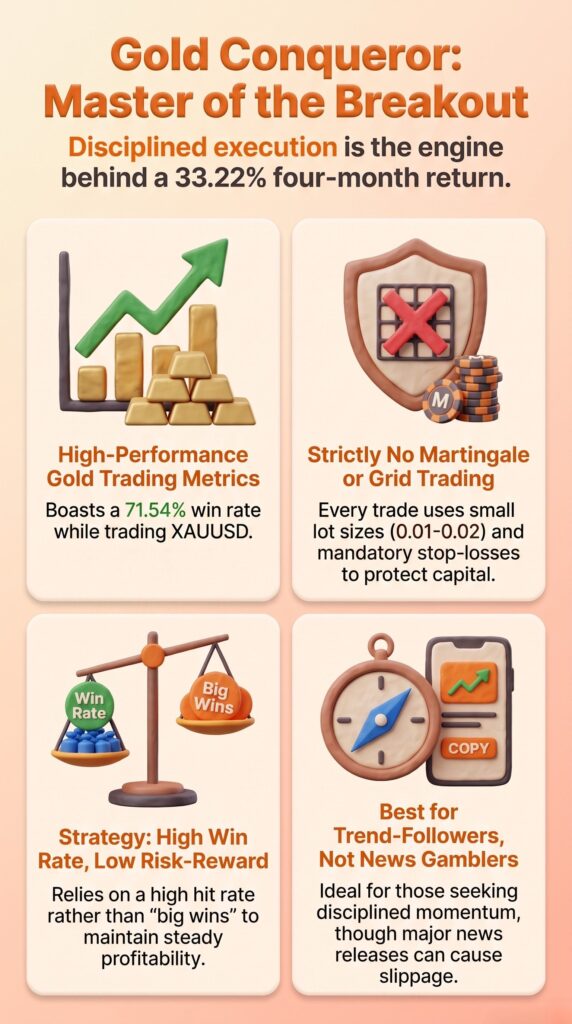
- Core Strategy: An automated EA trading XAUUSD breakouts around key support/resistance levels without using risky Martingale or grid techniques. It relies on strict stop-losses, fixed 0.01–0.02 lot sizes, and trailing stops to lock in profits.
- Key Performance Metrics (4-Month Record):
- Return: +33.22% time-weighted return (+$467.30 net profit).
- Win Rate & Payoff: 71.54% win rate across 260 trades, compensating for a lower 0.59 risk-reward ratio.
- Drawdown & Ranking: 16.44% max drawdown, ranked 14th by MMR on Tradingcup.
- Trade Duration: Most profitable when trades resolve quickly under 15 minutes; longer holds (>60 mins) generated notable losses.
- Primary Risks: High-impact economic news events (e.g., US inflation data) can trigger severe slippage and rapid stop-outs, suggesting the strategy needs a news filter. Prolonged range-bound chop also risks consecutive false-breakout losses.
Disclaimer: The information in this article is for educational purposes only and does not constitute financial, investment, or trading advice. Copy trading carries substantial risks, including the potential loss of your entire invested capital. Past performance of copied traders or strategies is not a reliable indicator of future results. You may be replicating high-risk trades, overleveraged positions, or strategies incompatible with your financial goals. Always conduct independent research into a trader’s historical performance, risk metrics, and strategy before copying them. Never invest funds you cannot afford to lose. Consult a licensed financial advisor to ensure copy trading aligns with your risk tolerance, financial objectives, and regulatory requirements in your jurisdiction. This article does not endorse specific traders, platforms, or strategies, and all trading decisions remain your sole responsibility.
Over the past two months, the gold market has been anything but calm.
The Iran-US conflict, inflation and non-farm payroll data, policy expectations following Warsh’s appointment, yen intervention, and the bond market’s repricing of the interest rate path have all combined to amplify gold’s volatility. The World Gold Council has also listed risk and uncertainty, exchange rates, the opportunity cost of interest rates, and market momentum as key drivers of gold prices in 2026.

This kind of environment isn’t suited to predicting a bottom, but it does create favorable conditions for trend-following breakout strategies: when price truly leaves a consolidation range, direction and volatility expand together. Capturing gold’s breakout momentum can effectively improve a strategy’s win rate.
Gold Conqueror, which has performed impressively recently, is a prime example of this logic in action.
A 33.22% Return in 4 Months — Why Does Gold Conqueror Stand Out?
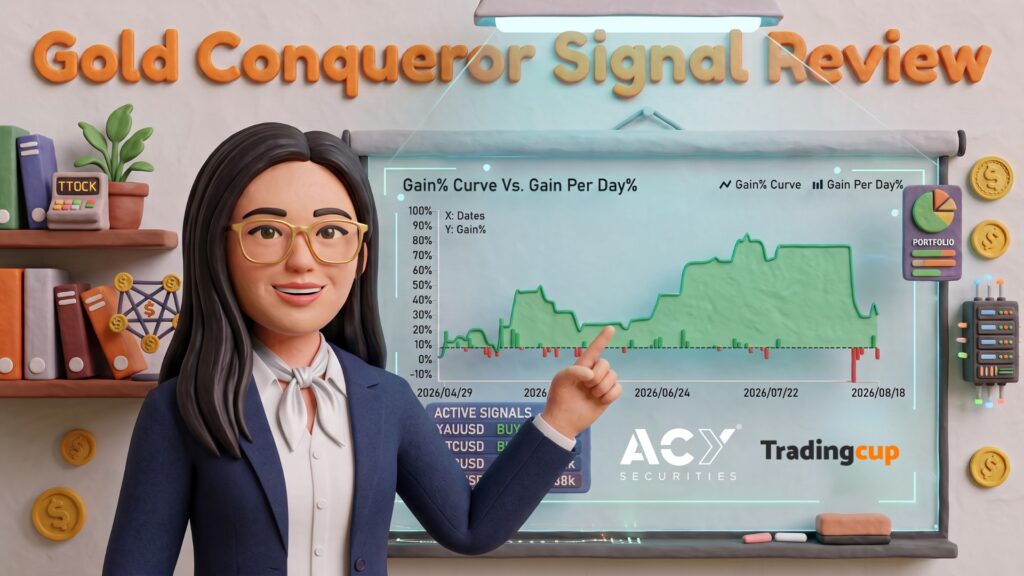
As of August 13, 2026, the Tradingcup signal Gold Conqueror has been running for about 4 months. It’s an automated EA strategy trading gold exclusively. Time-weighted return stands at 33.22%, maximum drawdown at 16.44%, and it currently ranks 14th by MMR. The account has completed 260 gold trades, with a 71.54% win rate and net profit of +$467.30.
The trading framework behind Gold Conqueror is based on the well-known automated EA strategy Gold Reaper. Simply put, it’s a breakout strategy that watches key support/resistance levels: it only enters once price approaches these important levels and multiple signals confirm simultaneously — and those signals are drawn from diverse sources rather than relying on a single indicator.
It doesn’t try to guess whether a given piece of news is bullish or bearish — instead, it doesn’t guess direction at all. It simply waits for price to pick a side at key levels and start trending, then follows along.
This fits well with gold’s recent price behavior: with frequent news-driven catalysts, gold often stays quiet during calm periods and then swings sharply once it moves. This “quiet until it isn’t” market rhythm happens to be the environment where breakout strategies perform best.
No Martingale, No Grid: Risk Control Built Into the Algorithm
The real risk with gold EAs isn’t the occasional stop-loss — it’s the martingale approach of adding to losing positions to average down. It looks fine when things go well, but the account can be wiped out quickly once the market reverses. Gold Conqueror is explicit on this point: no martingale, and every trade carries a stop-loss.

Looking at the account details, all 260 orders used only 0.01 or 0.02 lot sizes, with no sign of scaling up after losses. The maximum number of concurrent open positions reached 9, but this looks more like staged position-building than doubling down after a loss.
The take-profit and stop-loss settings also reflect active management. 77 orders with take-profit levels set earned a combined $955.39, with an 89.61% win rate — showing that profits are realized at preset targets when appropriate. On the stop-loss side, 111 orders ultimately closed at a loss, 15 were moved to breakeven, and 134 were moved into profit-locking territory — meaning more than half of all stop-losses were actively adjusted to a more favorable position.
Overall, the logic of this approach is to first use stop-losses to control losses, then move the stop-loss up to lock in profit once the trade moves favorably — a clear and coherent strategy.
Breakout Strategies: Win Rate Is Everything
By the time a breakout entry is triggered, the move has often already used up some of its momentum, leaving relatively limited room for take-profit. At the same time, the stop-loss can’t be set too tight, or it risks getting triggered by false breakouts. This creates a structure of “small take-profit, large stop-loss.” This inherently low risk-reward ratio means breakout strategies must rely on a higher win rate to stay profitable.
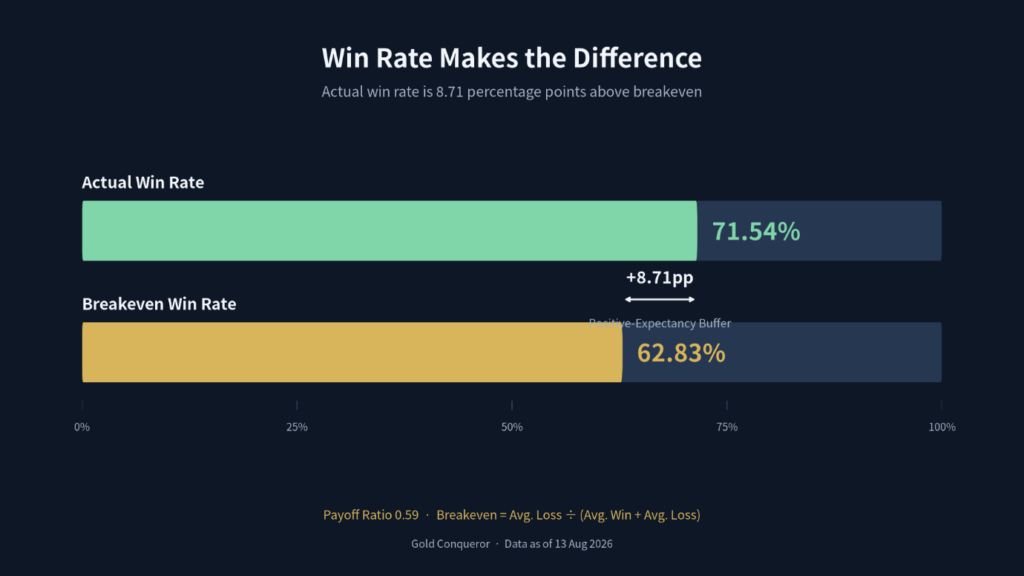
The data bears this out: average profit of $7.67, average loss of $12.97, a risk-reward ratio of about 0.59, and a theoretical breakeven win rate of 62.83% — while the actual win rate is 8.71 percentage points higher. Gold Conqueror isn’t relying on a handful of big wins to carry the account; it’s maintaining positive returns through a higher hit rate despite a low risk-reward ratio.
Holding time tells a similar story: the 201 trades held for under 15 minutes contributed a combined $794.88, while of the 15 trades held for over 60 minutes, 12 were losses totaling -$321.97. Genuine breakouts typically play out quickly — trades that fail to break free of the range tend to get ground down by chop.
Signal Risk: Major Data Releases Can Still Cause Unexpected Losses
This isn’t a low-volatility signal. As of August 14, Gold Conqueror’s Calmar ratio is just under 2, indicating that behind the impressive returns lies meaningful volatility risk.
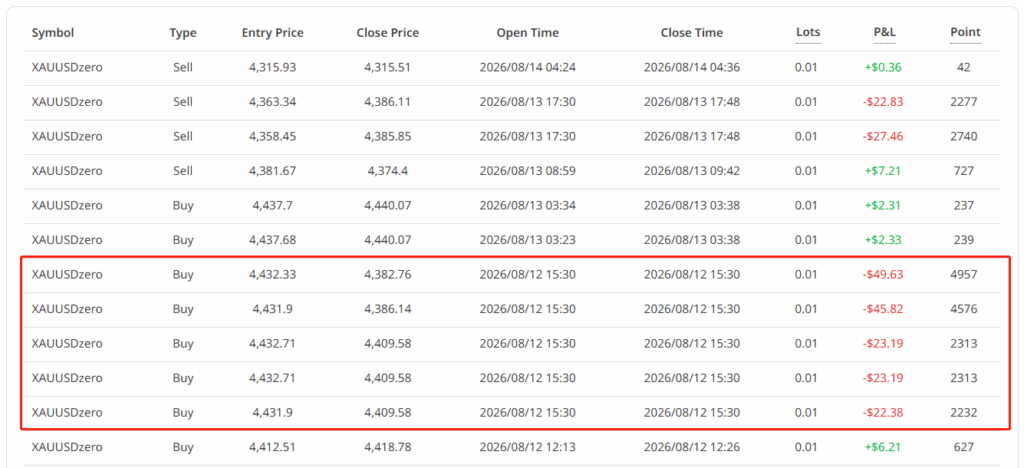
The account’s largest single-day loss occurred just the day before (August 12): the signal placed five buy orders at the exact moment US inflation data was released. Within seconds, gold prices swung sharply and moved in one direction, triggering the stop-losses; combined with negative slippage from thin liquidity during the data release, some orders’ actual losses exceeded their preset stop-loss levels. The day ended with a total loss of $164, which pushed up the signal’s maximum drawdown and knocked it out of the overall top ten rankings.
This also suggests that automated strategies like this should consider implementing a “major data filter” (such as an NFP filter) to pause or reduce trading frequency around key data releases, in order to avoid extreme event-driven volatility.
Gold Has Momentum — the Strategy Needs Discipline
Over the next six months, if factors such as shifting rate expectations, bond market volatility, and geopolitical risk persist, gold prices could enter a period of clear directional movement (i.e., sustained upward or downward trends rather than range-bound trading). Breakout strategies tend to perform well in this kind of environment.
Two factors are currently driving gold’s volatility:
- Comments from Fed official Warsh haven’t fully convinced the market, adding to uncertainty around rate expectations — uncertainty that feeds through to gold prices.
- A rebound in AI-related supply chains has lifted silver prices, and rising silver tends to amplify gold’s volatility as well.
One important caveat: strong recent performance doesn’t guarantee it will continue. If gold moves into an extended period of range-bound consolidation, the risk of false breakouts and consecutive stop-losses will rise accordingly.
Closing Thoughts
Gold Conqueror‘s value doesn’t come from using martingale or grid-based position sizing to mask risk — it comes from directly confronting gold’s high volatility through preset take-profit/stop-loss levels, breakeven and profit-locking adjustments, and disciplined breakout execution. Rather than focusing solely on the 4-month return figure, investors should pay closer attention to how the strategy manages drawdowns, trade pacing, and major data-release windows, and should participate with position sizes matched to their own risk tolerance.
Ultimately, what will determine this strategy’s future performance isn’t whether gold rises every day — it’s whether it can maintain disciplined execution through periods of sharp price volatility.
Looking for the Best Copy Trading Strategy?
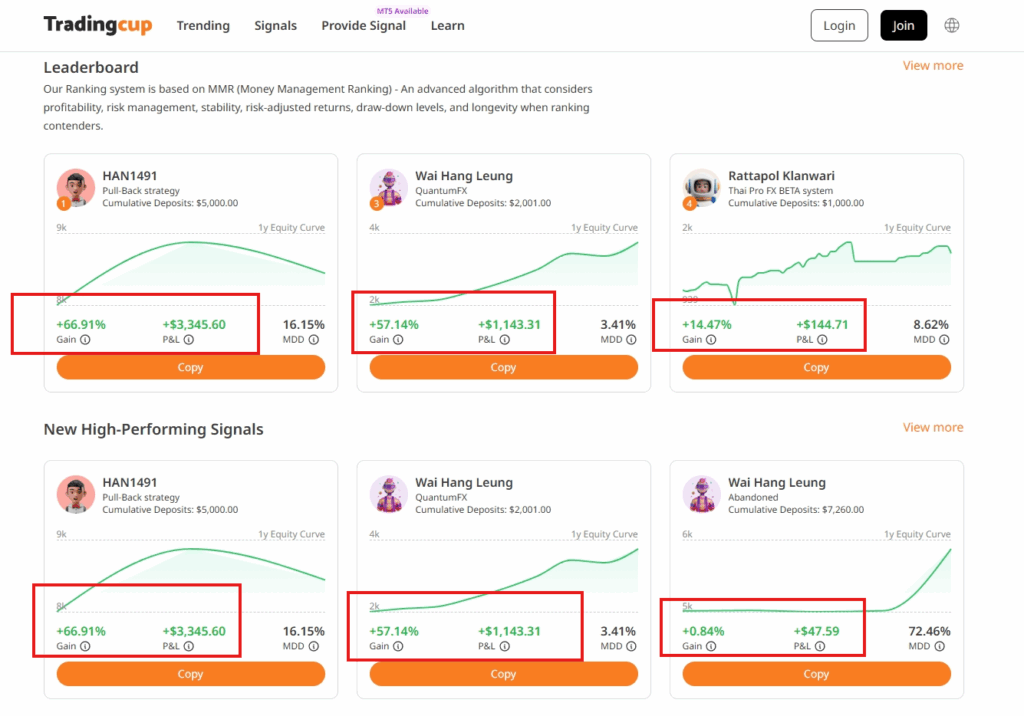
We’ve compiled a leaderboard of the most outstanding traders with excellent drawdown control and clear trading styles. This way, you’ll never feel lost when choosing who to follow and won’t blindly chase trends. Click to view the latest trader rankings and find out who is truly worth copying! Choose the right person, copy the right strategy, and from today, let copy trading truly create value for you.
Bonus Guide
What Makes an Effective Trading Portfolio?
- Diversification: Spread funds across various asset types (e.g., stocks, bonds, real estate, cash, precious metals) and industries/regions to reduce exposure to single-market volatility.
- Asset Allocation: Tailor allocations based on your risk tolerance, goals, and time horizon. Conservative portfolios emphasize fixed income, while aggressive ones lean into equities.
- Risk-Reward Balance: Each asset has different risk/return profiles. Ensure your portfolio avoids excessive exposure to high-risk or low-return assets.
- Low Correlation: Combine assets with correlations below 0.3 to enhance stability and provide a cushioning effect during market swings.
- Dynamic Rebalancing: Review and adjust your portfolio regularly as markets or personal goals change to stay aligned with your risk-return expectations.
- Clear Objectives: Define your financial goals (retirement, housing, education) before designing your strategy and time horizon.
- Discipline & Logic: Stick to your trading plan without emotional decision-making. Regularly reassess assumptions and market conditions.
(Disclaimer: This article is for informational and educational purposes only. It should not be considered financial advice. Always conduct your own research and consult with a qualified financial advisor before making any trading decisions.
For more detailed insights on developing daily trading routines, risk management, and effective position sizing strategies, explore additional articles on Trading Cup. Our trading experts at ACY and FinLogix are also great resources to guide your journey towards trading excellence.

Discover Our Best Trading Signals
At Tradingcup, you can browse through a selection of signals and review past performance before you decide to copy.
Become A Signal Provider
Share your expertise and become a signal provider so other traders can copy your trades.
Stay tuned to our blog for more trader spotlights and leaderboard updates.
Trading involves risks.
Visit the Tradingcup blog through the link below for more updates: https://www.tradingcup.com/learn
Related Copy Trading blogs:
- Understanding Market Liquidations: Liquidity Sweeps and Runs Explained
- 7 Essential Daily Habits of Successful Traders to Outperform Their Peers
- 10 Strategies You Can Copy off Our Best Copy Traders
- 5 Strategies Every Trader Can Master To Trade Better In A Trading Contest
- 2026 Copy Trading Scams Exposed: How to Spot Fraud
- A Swing Trading Strategy with an 83 Percent Win Rate and Low Drawdowns
- Forex Martingale Strategies Explained, The Good, The Bad and The Ugly
- Pyramiding Trading Tutorial – Pros & Cons & How to Use It