
Best Trading Strategies of Top Traders? Leaderboard Comparison

TradingCup
APR 16 2025
Last Updated: April 16, 2025
This article is reviewed annually to reflect the latest market regulations and trends.

Best Trading Strategies of Top Traders: April 2025 Leaderboard Deep Dive & Risk Guide
The allure of financial markets is undeniable. Stories of traders turning modest sums into fortunes echo across forums and social media. But beneath the surface of potential riches lies a complex world demanding skill, discipline, and strategy. Aspiring traders often look to the “top traders” – those seemingly mastering the markets – asking: What are their secrets? What are the best trading strategies?
This deep dive compares top trader strategies using TradingCup leaderboard, explores popular trading styles, typical costs, common pitfalls, and crucially, how to protect your capital. Forget get-rich-quick illusions; this is about understanding the landscape, learning from the leaders (and their risks), and trading smarter in 2025.
TL;DR: Best Trading Strategies of Top Traders April 2025
- Diverse trading approaches dominate the leaderboard: scalping (EUR Specialist), swing trading (Pull-Back Strategy), EA-based (Royal Mint), and Martingale systems (Jeff Ng).
- Top performers: Ky Wong (+163%), Pull-Back Strategy (+129%), and Forex_Pair (+53%) lead in profitability, while Thai Pro FX offers lowest drawdown.
- Key pairs: EURUSD, XAUUSD, exotic pairs (NZDJPY/EURAUD), and crosses (AUDCAD/NZDCAD); most active during London and NY sessions.
- Copy trading costs: Subscription fees range from $0-$30/month with performance fees from 1-30%.
- Widespread scams: EA manipulation, falsified backtests, unrealistic zero-drawdown claims, and hidden Martingale systems require thorough due diligence.
Introduction: The Trading Leaderboard Landscape in April 2025
The forex trading world in 2025 has evolved dramatically, with copy trading platforms showcasing both legitimate talent and questionable strategies. This comprehensive analysis examines all nine top-performing traders across various styles, instruments, and risk profiles, helping you navigate this complex landscape with greater confidence and protection for your capital.

“The difference between successful and unsuccessful traders isn’t intelligence—it’s discipline and risk management.” – Mark Minervini
Top Trading Styles Among Leading Traders
Scalping Specialists
- EUR Specialist employs rapid EURUSDzero scalping with impressive +55.22% gains but concerning 42.73% drawdown.
- Trade Horizons utilizes automated bot scalping exclusively on XAUUSD, claiming 0% drawdown (which demands skepticism).
- Forex_Pair combines EA-based scalping on XAUUSDzero and major pairs for +53.93% returns with 33.51% drawdown.
- Jeff Ng uses Martingale-enhanced scalping on precious metals with moderate 9.06% drawdown.
Swing & Position Trading
- Pull-Back Strategy employs SMA/RSI indicators for swing trades on AUDNZD and ETHUSD (+129.72% gains).
- Thai Pro FX focuses on conservative long-term XAUUSDzero positions with minimal 8.62% drawdown.
- Royal Mint EA targets steady swing gains (+22.32%) on AUDCADzero and NZDCADzero pairs with 33.44% drawdown.
Mixed & Specialized Approaches
- Ky Wong trades exotic pairs like NZDJPY and EURAUD with market-leading +163.31% returns and 16.88% drawdown.
- Macpaul adopts a cautious mixed approach on EURUSD and GBPNZD with 9.52% drawdown.
Complete Leaderboard Overview & Analysis
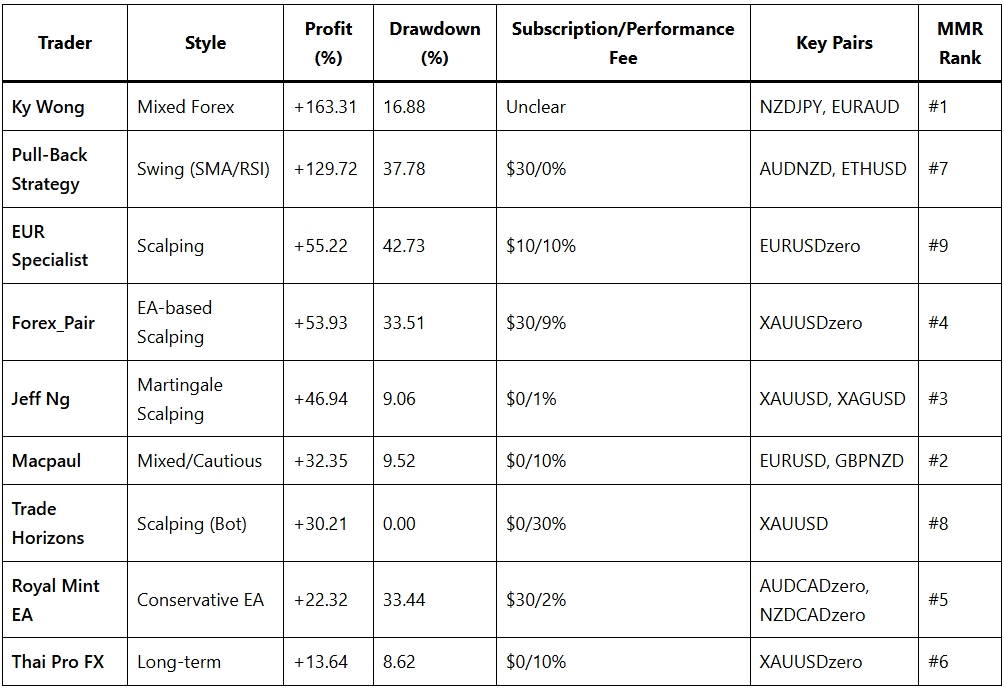
Trader-by-Trader Breakdown
Ky Wong:
- Style: Mixed Forex (High Risk). Trades exotic pairs.
- Performance: +163.31% Gain (Highest). Moderate Drawdown (16.88%) – relatively good for the return, but still significant potential loss.
- Fees: Unclear. Again, lack of transparency is a concern.
- Instruments: NZDJPY, EURAUD (Exotics).
- Notes: Highest returns often come from higher-risk strategies or pairs. Exotic pairs can have wider spreads and higher volatility. Inconsistent risk control mentioned in comparison metrics is a red flag.
Pull-Back Strategy:
- Style: Swing Trading (using SMA/RSI). Holds trades for hours/days.
- Performance: +129.72% Gain (Very High). High Drawdown (37.78%).
- Fees: $30/month Sub / 0% Performance Fee.
- Instruments: AUDNZD, ETHUSD (Forex and Crypto).
- Notes: Demonstrates the potential of swing trading but also the inherent risk (significant drawdown). A fixed subscription fee might be preferable for larger accounts compared to high performance fees. Diversification across asset classes (Forex/Crypto) is noted.
EUR Specialist:
- Style: Scalping (Manual). Focuses intensely on EURUSDzero.
- Performance: +30-40% (stated per trade, which seems exceptionally high and needs clarification – likely overall monthly/period gain goal). High Drawdown (42.73%) indicates significant risk.
- Fees: $0 Sub / $10 Fees.
- Notes: Specializing in one pair can build expertise but also concentrates risk. The high drawdown suggests aggressive trading or poor risk control at times.
Forex_Pair:
- Style: EA-based Scalping (EU/GU mentioned, but trades XAUUSDzero on list). Warns against manual changes.
- Performance: +53.93% Gain. High Drawdown (33.51%).
- Fees: $30/month Sub / 0% Performance Fee.
- Notes: Highlights the reliance on automation. The high drawdown, despite EA use, shows bots aren’t risk-free. Warning against manual intervention is common for EA providers.
Jeff Ng:
- Style: Martingale Scalping (High Risk). Uses Stochastic/MACD.
- Performance: +46.94% Gain. Low Drawdown (9.06%) – if accurate, surprisingly low for Martingale.
- Fees: $0 Sub / 1% Performance Fee (Very Low).
- Instruments: XAUUSD, XAGUSD (Gold & Silver).
- Notes: Martingale (doubling bets after losses) is extremely risky and can wipe out accounts quickly, despite potentially low drawdowns until a long losing streak hits. The low reported drawdown needs heavy scrutiny. Trading precious metals is common.
Macpaul:
- Style: Mixed/Cautious. Trades diverse pairs.
- Performance: +32.35% Gain. Low Drawdown (9.52%).
- Fees: $0 Sub / 10% Performance Fee.
- Instruments: EURUSD, GBPNZD (Major and Cross).
- Notes: Appears to be a balanced approach, decent return with controlled risk. Diversification across different pair types.
Trade Horizons:
- Style: Scalping (Bot/EA). Trades XAUUSD (Gold), avoids news.
- Performance: +30.21% Gain. High 30% Performance Fee.
- Notes: While bots can be precise, they aren’t immune to market shocks. The high-performance fee eats significantly into copier profits.
Royal Mint EA:
- Style: Conservative EA. Targets modest gains.
- Performance: +22.32% Gain. High Drawdown (33.44%) – surprisingly high for a “conservative” label.
- Fees: $30/month Sub / 2% Performance Fee.
- Instruments: AUDCAD, NZDCAD (Commodity Crosses).
- Notes: The “conservative” label clashes with the high drawdown. Highlights the need to look beyond labels. Low performance fee is attractive.
Thai Pro FX:
- Style: Long-term (Position Trading). Focuses on XAUUSDzero.
- Performance: +13.64% Gain. Low Drawdown (8.62%).
- Fees: $0 Sub / 10% Performance Fee.
- Notes: A more conservative approach reflected in lower gains but significantly lower risk (drawdown). Suitable for risk-averse followers.
Key Comparison Metrics Unpacked
The Trader’s metrics offer deeper insights:
- Trading Style & Strategy: Confirms the variety – fast scalpers (EUR Specialist, Trade Horizons), methodical swing/position traders (Pull-Back, Thai Pro FX), automated EAs (Forex_Pair, Royal Mint), and high-risk approaches (Ky Wong, Jeff Ng). Knowing the why behind the trades is as crucial as the results.
- Profitability & Risk (Drawdown): This is the core trade-off. Ky Wong and Pull-Back offer >100% gains but expose copiers to potential 16-38% losses from the peak equity. Trade Horizons’ 0% drawdown is highly questionable. Thai Pro FX and Macpaul offer stability but lower returns. Ask yourself: Can my account (and stomach) handle the potential drawdown of a high-return strategy?
- Position Size & Risk Management: Most use small lots (0.01-0.03) per $1k-$2k capital, suggesting basic risk control. However, Jeff Ng’s Martingale explicitly increases risk after losses. EUR Specialist’s 0.01 lots per $1k rule is a simple risk metric. Ky Wong’s noted inconsistency (e.g., large losses) is a major warning sign. Proper risk management is non-negotiable.
- Fees: Fees directly impact your net profit. High performance fees (like Trade Horizons’ 30%) require the trader to generate significantly higher gross returns for the copier to make decent net profit. Subscription fees ($30/month) are fixed costs regardless of performance. Zero fees (like Thai Pro FX sub) are attractive but always verify overall performance and risk.
- Trade Frequency: Scalpers trade dozens of times daily, requiring robust platforms and potentially incurring higher cumulative spread/commission costs. Low-frequency traders (Thai Pro FX, Royal Mint EA) incur fewer transaction costs but require patience.
Matching Strategies to Trader Profiles:
- Aggressive: Jeff Ng (Martingale – Extreme Caution Advised), Pull-Back Strategy (High Reward/Risk).
- Conservative: Thai Pro FX (Low Drawdown), Macpaul (Cautious Mix), Royal Mint EA (Verify Drawdown).
- Automation Lovers: Trade Horizons (Verify Drawdown Claim), Forex_Pair, Royal Mint EA.
- Forex Enthusiasts: Macpaul (Diverse), Ky Wong (Exotics – High Risk).
Hot Strategies Top Traders Are Using Now
Beyond the core styles, specific strategies gain prominence based on market conditions.
- Momentum Trading: Riding strong trends, often entering after significant news or breakouts, using indicators like RSI and MACD to gauge strength.
- Breakout Trading: Entering trades when price decisively breaks key support or resistance levels, often confirmed by high volume.
- Pullback Strategy: Waiting for a temporary price dip (pullback) within an established trend to enter in the trend’s direction, often using Fibonacci levels or moving averages.
- Range Trading: Identifying clear support and resistance levels and trading within that “box,” buying near support and selling near resistance (often using oscillators like RSI). Popular in less volatile periods.
- News Trading: Capitalizing on volatility around major economic releases (e.g., Non-Farm Payrolls, interest rate decisions). Requires speed and understanding of market expectations vs. reality.
- Price Action & Market Structure: As discussed on Reddit forums like r/Daytrading, many successful traders simplify, focusing purely on reading price charts (candlestick patterns), identifying market structure (higher highs/lows for uptrends, lower highs/lows for downtrends), and understanding liquidity zones (where orders cluster).
- Opening Range Breakout (ORB): A specific day trading tactic mentioned frequently on Reddit, involving trading breakouts from the high or low established within the first few minutes (e.g., 5, 10, 15 minutes) of the market open.
Forex Pairs & Trading Hours Comparison

Most Popular Instruments
- Gold (XAUUSDzero/XAUUSD): Traded by Trade Horizons, Forex_Pair, Jeff Ng, Thai Pro FX
- EURUSD/EURUSDzero: Primary focus for EUR Specialist, also traded by Macpaul
- CAD Crosses: Royal Mint EA specializes in AUDCADzero and NZDCADzero
- Exotic Pairs: Ky Wong focuses on NZDJPY, EURAUD for enhanced volatility
Optimal Trading Windows
- EUR Specialist: Active during London/NY sessions overlap (8 AM-12 PM EST) for maximum EURUSD volatility
- Trade Horizons: Operates during specific windows, avoiding news releases
- Royal Mint EA: Active across multiple sessions with clear preference for Asian hours for CAD crosses
- Ky Wong: Trades exotic pairs during Asian session when NZDJPY liquidity peaks
Trading Pattern Analysis
- Lot Sizing: Most traders use 0.01-0.03 lots per $1000 capital (EUR Specialist recommends 0.01 per $500-1000)
- Trade Duration: Varies significantly—EUR Specialist (minutes), Pull-Back Strategy (hours/days), Thai Pro FX (days/weeks)
- Trade Frequency: Trade Horizons executes multiple quick trades, while Royal Mint EA places fewer, longer-duration positions
Optimal Trading Times: Leveraging Market Sessions
The Forex market operates 24 hours a day, 5 days a week, across overlapping global sessions (Sydney, Tokyo, London, New York). Liquidity and volatility fluctuate significantly:
- Sydney Session: (Approx. 5 PM – 2 AM EST / 5 AM – 2 PM PHT) – Starts the trading week, typically quieter.
- Tokyo Session: (Approx. 7 PM – 4 AM EST / 7 AM – 4 PM PHT) – Overlaps with Sydney. Asian pairs (like USD/JPY) see more activity.
- London Session: (Approx. 3 AM – 12 PM EST / 3 PM – 12 AM PHT) – Highest volume session, significant volatility, especially at the open. Major European news releases.
- New York Session: (Approx. 8 AM – 5 PM EST / 8 PM – 5 AM PHT) – Second highest volume, overlaps significantly with London. Major US news releases.
Key Overlaps (Peak Activity Times):
- London/New York Overlap (8 AM – 12 PM EST / 8 PM – 12 AM PHT): This is generally considered the best time to trade due to the highest liquidity and volatility. Most major news releases occur. Ideal for day traders, scalpers, and breakout strategies.
- Sydney/Tokyo Overlap (7 PM – 2 AM EST / 7 AM – 2 PM PHT): Good activity for AUD, NZD, JPY pairs.
- London/Tokyo Overlap (3 AM – 4 AM EST / 3 PM – 4 PM PHT): Brief overlap, can see some volatility spikes.
Traders often tailor strategies to specific sessions. For instance, range trading might work better during the quieter Asian session, while trend and breakout strategies thrive during the London/NY overlap
Copy Trading Costs & Subscription Comparison

Subscription Fee Structures
- Free Subscriptions: Thai Pro FX, Jeff Ng, Macpaul, Trade Horizons
- Low-Tier ($10/month): EUR Specialist
- Premium Tier ($30/month): Forex_Pair, Pull-Back Strategy, Royal Mint EA
Performance Fee Comparison
- Low (0-2%): Pull-Back Strategy (0%), Jeff Ng (1%), Royal Mint EA (2%)
- Mid (9-10%): Forex_Pair (9%), Thai Pro FX (10%), Macpaul (10%), EUR Specialist (10%)
- High (30%): Trade Horizons
Value Analysis
- Best Value: Jeff Ng ($0 + 1% performance) for cost-conscious traders
- Premium Value: Royal Mint EA ($30 + 2%) for those prioritizing steady returns
- Balanced Option: Thai Pro FX ($0 + 10%) for lower risk tolerance
Navigating the Pitfalls: Common Trading Scams & Red Flags

The potential for profit attracts scammers. Be vigilant and learn to spot the warning signs.
The Lure of Fake Results: Unmasking Deception
- Unrealistic Returns: Promises of guaranteed high returns (50%, 100%, 200%+) are almost always scams. Legitimate trading involves risk.
- Perfect Track Records: Leaderboards showing massive gains with zero or suspiciously low drawdowns (like Trade Horizons’ 0%) warrant extreme skepticism. Real trading involves losses.
- Lack of Verification: Results shown only as screenshots or on the provider’s own website without third-party verification (like Myfxbook or broker-verified performance) can be easily faked.
Expert Advisor (EA) Backtest Manipulation Explained
Backtesting simulates how an EA would have performed on historical data. While useful, results can be misleading or manipulated:
- Ignoring Spreads/Slippage: Backtests might use fixed, unrealistically low spreads or ignore variable spreads and slippage (difference between expected and actual execution price), massively inflating performance (as highlighted by CentralCharts). Real market conditions are harsher.
- Calculation Issues: Some platforms might only calculate based on candle close prices, missing crucial intra-candle movements where real trades or stop-losses might have triggered differently.
- Curve Fitting: Optimizing an EA’s parameters to look perfect on past data. This often fails miserably on live data as market conditions change.
- Solution: Look for EAs tested on multiple brokers/data feeds, with realistic spread/slippage settings, and ideally, a verified live trading record over several months. ProRealTime is mentioned as having more realistic backtests than some others.
How to Spot a Trading Scam (Based on CFTC Guidance)
- Unsolicited Contact: Strangers contacting you via social media, messaging apps, or email pushing a trading platform or strategy.
- Unregistered Platforms: Legitimate brokers/platforms dealing with Forex, Futures, Options, or Crypto are usually registered with regulatory bodies (e.g., CFTC, NFA in the US; check your local regulator). Scam sites often aren’t.
- Fake/Offshore Address: No physical address, a clearly fake one, or located in a loosely regulated offshore jurisdiction.
- No Phone Support: Reliance solely on chat (often bots) or email, with no verifiable phone number.
- Website Age Mismatch: Claims of being established for years, but the website domain was registered recently (check using tools like lookup.icann.org).
- Crypto Transfer Requests: Asking you to buy crypto on a legitimate exchange and then transfer it to their platform. This bypasses financial regulations and makes funds untraceable. Legitimate brokers usually accept bank transfers, cards, etc.
- Guaranteed High Returns/Investment Plans: Promises tied to how much you deposit.
- Poor Website Quality: Spelling errors, bad grammar, broken links (“under construction” pages).
- Fake Awards/Testimonials: Generic awards from unknown organizations or glowing testimonials only found on their site. Search externally for reviews mentioning “scam” or “fraud.”
Beyond Profits:

Trading isn’t just about making money; it’s about not losing it unnecessarily. This requires discipline and robust risk management.
The Psychology of Risk
As trading quotes emphasize, your biggest enemy is often yourself. Fear and greed drive poor decisions.
- Fear: Causes premature exits from winning trades or paralysis preventing entry into good setups.
- Greed: Leads to overtrading, chasing risky setups, or holding losing trades too long hoping for a reversal (“hope is not a strategy”).
- Discipline: Sticking to your trading plan and risk rules, even when uncomfortable, is crucial. As Mark Douglas said, “The consistency you seek is in your mind, not in the markets.”
The world of trading strategies is vast, and leaderboards offer a glimpse into what’s possible – both in terms of profit and risk. While studying top traders can be insightful, blindly copying without understanding the strategy, risks, fees, and potential for scams is a recipe for disaster.
True success lies in finding a strategy that aligns with your personality, risk tolerance, and time commitment. Focus on mastering the fundamentals: price action, market structure, and above all, disciplined risk management. Protect your capital diligently, learn continuously, and remember Warren Buffett’s wisdom: “Risk comes from not knowing what you’re doing.” Trade informed, trade safely, and aim for consistency over unrealistic jackpots.
Frequently Asked Questions (FAQs)
Q1: What is the absolute best trading strategy for beginners?
A: There’s no single “best” strategy. Beginners often start with simpler approaches like basic swing trading or position trading using major Forex pairs (like EUR/USD) due to lower volatility and ample educational resources. Focus on learning risk management and price action basics before attempting complex strategies like scalping or Martingale. Demo trading is crucial first.
Q2: How much does it really cost to copy trade?
A: Costs vary. Some brokers offer it “free” (built into spreads), while others charge monthly subscription fees ($10-$50+) and/or performance fees (10%-30%+ of profits) to the signal provider. Always check the fee structure before copying.
Q3: Is Scalping a profitable strategy?
A: Scalping can be profitable but is very demanding. It requires intense focus, quick execution, low spreads/commissions, and robust technology. Small profits per trade must overcome transaction costs. It’s generally not recommended for beginners due to its intensity and high frequency.
Q4: How can I verify if a top trader’s results are real?
A: Look for results verified by independent third-party platforms (like Myfxbook, MQL5 Signals with real account verification) or directly by the broker. Be skeptical of results shown only as screenshots or on the trader’s own unverified website. Consistent, long-term performance (6+ months) with realistic drawdowns is more trustworthy than short bursts of extreme profit.
Q5: Are Trading Bots / Expert Advisors (EAs) scams?
A: Not all EAs are scams, but many are marketed with unrealistic expectations or manipulated backtests. Legitimate EAs exist, but require careful vetting. Look for transparent logic, realistic backtests (considering spread/slippage), long-term verified live performance, and user reviews from reputable sources. Avoid EAs promising guaranteed riches or showing perfect, curve-fitted backtests.
For more detailed insights on developing daily trading routines, risk management, and effective position sizing strategies, explore additional articles on Trading Cup. Our trading experts at ACY and FinLogix are also great resources to guide your journey towards trading excellence.

Discover Our Best Trading Signals
At Tradingcup, you can browse through a selection of signals and review past performance before you decide to copy.
Become A Signal Provider
Share your expertise and become a signal provider so other traders can copy your trades.
Stay tuned to our blog for more trader spotlights and leaderboard updates.
Trading involves risks.
Visit the Tradingcup blog through the link below for more updates: https://www.tradingcup.com/learnBest blogs top 8 code to use if needed.
Related Copy Trading blogs:
- Understanding Market Liquidations: Liquidity Sweeps and Runs Explained
- 7 Essential Daily Habits of Successful Traders to Outperform Their Peers
- 10 Strategies You Can Copy off Our Best Copy Traders
- 5 Strategies Every Trader Can Master To Trade Better In A Trading Contest
- 2025 Copy Trading Scams Exposed: How to Spot Fraud
- A Swing Trading Strategy with an 83 Percent Win Rate and Low Drawdowns
- Forex Martingale Strategies Explained, The Good, The Bad and The Ugly
- Pyramiding Trading Tutorial – Pros & Cons & How to Use It